Thursday, April 3, 2014

I'm Siena Another Italian City (it's a stretch)

Siena is the capital of Tuscany, a hill top walled city much like any other found hiding within the rolling hills of the northern Italian countryside. Its long and narrow corridors, labyrinthine in layout, all flow into, or near its jewel; the piazzo del campo. Today, the large, circular square is a lounge for students and tourists to rest in the shadow of the city hall. On July 2nd, its transformed into the stage where Il Palio takes place; a near 450 year old bareback horse race where riders from the different districts of Siena race against each other for the honor of their home (yes, its a little Hunger Games-esque).


For me, I just basked in the sun on my day off from living with a family, doing manual work in exchange for meals and a place to sleep. The Palio would have been the site to see, but my timing was off and the enormous gothic cathedral nearby was ready to open it's doors at 10:30.

The cathedral stands on two levels between two streets on different sides of a hill. The whole city deals with the verticality, but the church occupies a block, presenting itself as its own mountain in a hilly city. As you approach, its immediately clear that this is something special. The facade, and later to be discovered interior, are built in alternating black and white marble. The striping adds to its vertical spectacle.


Inside, its even more impressive, as if walking into a marbled cave. Albeit, with stained glass windows and elaborate mosaic floors. The pulpit is an elaborate marble carved staircase placed where the church parishioners can have a clear view of their stately Cardinal. The floors exhibit, in addition to the cold stone slabs that mark the resting place or priest and patron, elaborate mosaics from the foundational churches medieval French influence, but the ceilings, in typical Italian flair, are carefully painted with frescoes in a way as to not take away from the architecture.


I found myself wandering the narrow streets, observing how such a city still operates confined by its building practices no longer necessary in a modern Italy. The bakeries still churned out biscotti and espresso. The more remote houses still strung their laundry across alleys. People would still be kneeling and praying at their district church. Cars were the only casualty, having to pause to let pedestrians through streets that were meant for horse and carriage.


As I made my way out of the city, I stopped by the old arena, catching the students of the musical school stumbling through an Eric Clapton guitar solo through an open window. I scaled the brick and stone walls, and landed on the upper wall parimeter to catch my final view of this uniquely similiar Tuscan city.


Monday, March 24, 2014

Tuscany Raiders

To summarize what Tuscany is, it would have to be complexity in simplicity. This defines their wines, their food, the houses, even the land the live on.


Pasta pomodoro is a simple dish. You usually take spaghetti, and lightly coat it in tomato sauce, and garnish with basil. Simple, delicious, oddly hard to do it justice (go to tourist trap restaurants, you'll see how easy it us to make bad pasta). What I fail to mention is the pasta has to be cooked right (lightly al dente). This aids in digestion, and makes it far easier to twirl around a fork. The sauce is naturally acidic and needs to be balanced to get the sweetness in the tomatoes to speak. Olive oil is used to coat the pasta before it sticks together. Enough to coat, and have the flavor add to the tomato. Lightly salt the pasta to enhance the flavor of everything. Add just enough basil to highlight and freshen the fruit flavors in the sauce.

The wines are no different. To you oenophiles, this is the Brunello, Chianti and Rosso territory. A stop at a winery will show you just how much subtlety and difference there is between 2, 5, and 10 year old bottles. Not to mention how a single type of grape can yield three different wines with completely different profiles.


The land is yet another UNESCO site. The rolling hills have been cultivated for thousands of years. It has managed the unique balance of natural beauty sculpted and curated by man. A birds eye view shows nothing more than a hilly agricultural landscape, but dive through the winding roads, across carefully built stone bridges, and you realize how specific and intentional every man made object is intended to compliment the natural curve and crevice if the land.


I write this sitting on a hill top, in a stucco, rock and clay villa. An ancient fortress look out from when the city-states of Montelchino were resisting Spanish invasion. This is my home for the next three weeks.


Monday, March 17, 2014

Firenze in a Strange Place

This is the city. The city where the renaissance started, and modern banking was born. This is the city known for its long history of architectural feats. This is the city known for its painters, its sculptors, its power. This is the city known for its rich textiles, still supplying designers the world over with the highest quality leather. This is Florence.


Now, since its UNESCO world heritage proclamation, it is a beacon for tourists. It's a mix of the rich historical tapestry that influenced western civilization, and Disneyland. Its no longer Italy. You don't walk down the street and hear Italians talking passionately. You hear English. Everywhere. You cant get delicate Tuscan cooking. You get pizza al taglio, and pasta al Americano, which is to say covered in sauce.

But what a city.


I walked in wonderment. Every palatial church at the end of a crooked, cobbled street never wore thin. The museums with art, hewn by hands of legend, never grew old. The views - and what views - never ceased to leave me speechless.


If you need to step outside the city to really understand why this was a cultural hub, you only need to climb away, across the river, up the adjacent hill, and stand atop of the old city walls.

The other side of the ancient city is a sweeping countryside. The hills resemble quilt work, actually vineyard and olive grove. Each square of agriculture guarded over by towering cyprus pines, standing silently for centuries. Hill side after hill side. Its the Tuscan country side; capable of supplying a bustling city with all of its needs to eventually grant the rise of the Medici and Borghese, as well as the renaissance.


This is Florence.


What a city.

Wednesday, March 12, 2014

Germany Roads Must a Man Walk Down

München

My train pulled into Munich station after a 10 hour train ride from Denmark, which included a ferry (I didn't even know they put trains on ferries). I was greeted by oddly dressed Germans in pirate, witch, princess and, uh, ethnic costume. At first I assumed I walked into the worlds worst flash mob, instead it was the beginning of Carnivalé. Given Munich's placement in Bavarian territory, it was a bid tradition.

It was just my luck. The whole central area in Munich was a slow crawling amorphous blob of people wrenching their way down crooked streets to get their fill of brats and beer. Who was I to deny this tradition? I joined in and had one of each. Word of warning: the Germans measure in litre, so when you have options of .2, .5 and 1, 1 is not a manageable beer size. Not to mention that the happy waiter at the bierhaus will gladly fill and place an enormous litre beer in from of you. They call it Hugo, appropriately so.


The crowds cleared as I ventured into the streets away from down town. This was a perfect opportunity to explore. I peered in every church and any public building that had an open door. Gothic architecture and stereotypical Bavarian houses were abundant, as were the enormous public parks.


Unfortunately, I was not in Munich for long before I was on my way to a city outside of Augsburg.

Ulm (pronounced oo-ilm)

It was sold to me as a medieval hamlet. Even better, it was a hamlet that my friends parents were willing to house me in. Here I was treated to a family that was more than willing to show me all their town had to offer. Here I experienced true German food, outside of sausages and flasks of beer.

Each place I was brought to had its own charm. 

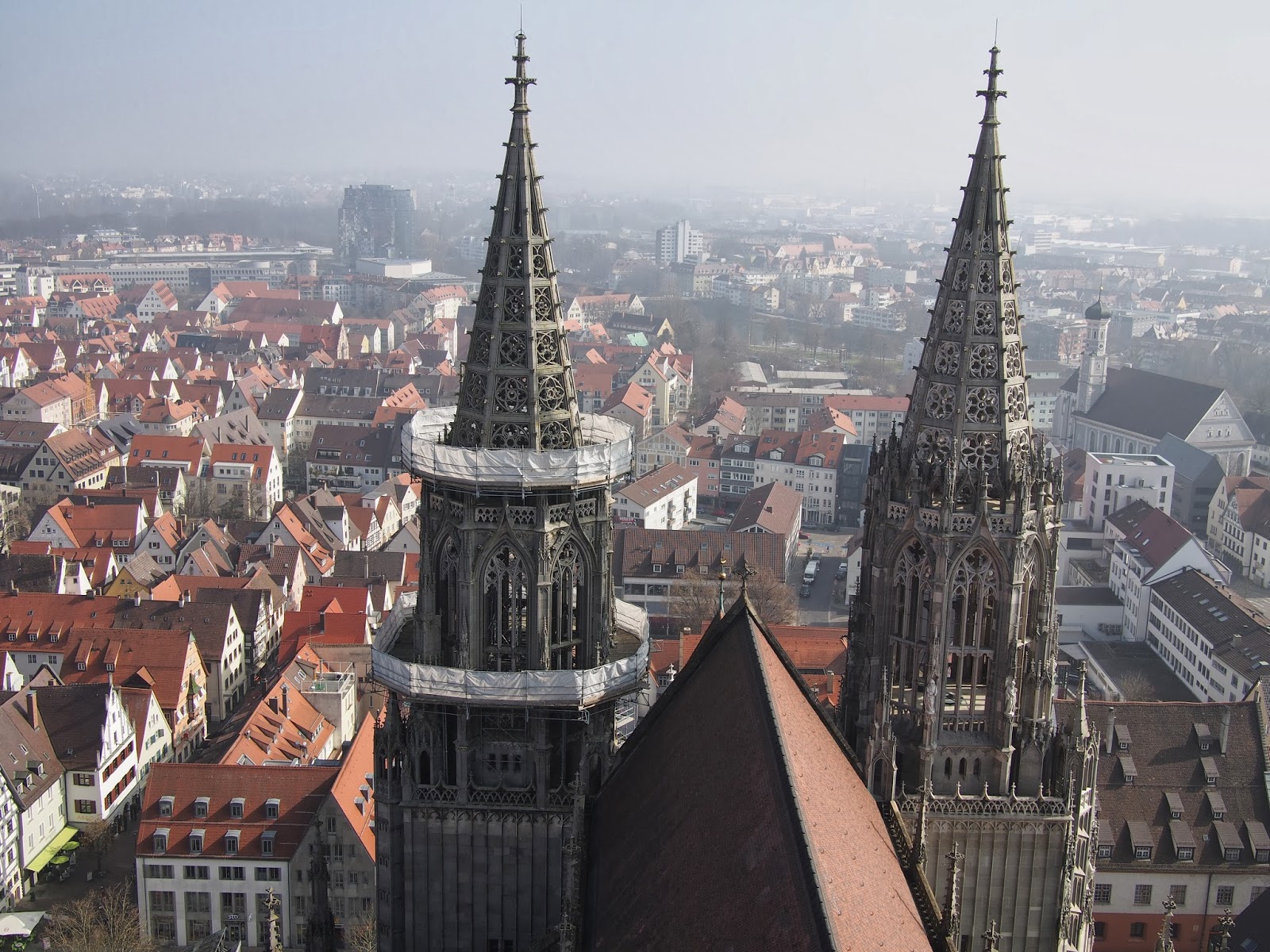
Ulm was a modern small city resurrected from destruction while maintaining parts of its medieval history. Its claim in the region was having the tallest church spire, which I climbed, and found out half way up that I have a crippling fear of heights. 


I was also taken to ancient basilica's that was taken by Napoleon and later rebuilt in Baroque style. I walked in old monasteries and saw what a Catholic community in the middle of Europe actually is - hint, they say god bless you when you walk into their towns.


Neushwanstein Castle

Ludwig II was a slightly insane inheritance king of Bavaria starting at the age of 18. He enjoyed Wagner and nice things like mountain top castles instead of things like state affairs. For better or worse, he used his power to create 5 castles during his rule. Unfortunately, he died at a young age for unknown reasons, but he left opulent castles as a cash cow legacy for what became the country of Germany. Disney liked it enough to model its castle after.